Pranks, Frauds, and Hoaxes
from Around the World
By Robert Carroll

Psychic
surgery procedure by a philippine "doctor", typically involving an alleged
creation of an incision using only the bare hands, the removal of pathological matter, and the spontaneous healing of the
incision.
It’s pretty easy to hoax people. We all want to be deceived, but only up to a point. Some hoaxes are fun and pleasant, others malicious and unpleasant.
We want to be deceived. —Blaise Pascal
..................
I think Pascal is
right. We want to be deceived. Deception is an essential tool for the survival
of our species. We might well be hardwired for deceiving others and taking
delight in being deceived. On the other hand, there are many times when we
don’t appreciate deceiving or being deceived. And most of us feel uncomfortable
when we’re not sure whether we’re being hoaxed. Is there any way to reconcile
our love of a good prank or magic trick with our hatred of being defrauded or
made to look foolish? Is there any surefire way to avoid being hoaxed?
Maybe. Maybe not.
Most of us have been
victims of pranks, hoaxes, or frauds. We may even have mistaken one for the
other. For example, in April 2002, in Loomis, California, two teenagers got
inspired by the MTV reality show Jackass. One of them videotaped his
buddy as he ran along a rural road wearing handcuffs and an orange jail
jumpsuit that he’d bought at a flea market. Unfortunately, some local citizens
and law enforcement officers didn’t know it was a prank, and they pursued the
“escapee” with tracking dogs, patrol cars, and a helicopter. Folsom Prison
ordered a full-scale lockdown and did a head count. They also did head counts
at the jails in Placer and Sacramento counties, at some expense to the
taxpayer.
It’s sometimes hard to
know whether something is a prank or a hoax or whether we’re being defrauded.
The jackass could well have been an escapee. If you saw someone in an orange
jumpsuit and handcuffs running down the road and you didn’t see the cameraman,
your first thought probably would not be: “Ah, another Jackass prank.”
Most of us have heard
of the 1938 Halloween Eve radio broadcast by Orson Welles of an adaptation of
H.G. Wells’s War of the Worlds that many took to be an announcement that
Earth had been invaded by Martians. Announcements that the story was fiction
were made four times during the broadcast. Welles ended the show by announcing
that the broadcast was a “holiday offering”: “the Mercury Theater’s own radio
version of dressing up in a sheet and jumping out of a bush and shouting boo.”
The disclaimers did little to prevent many people from believing we’d been
invaded by Martians. It’s been called the hoax of the century, but it wasn’t
even a hoax. It wasn’t a prank, either. It wasn’t intended to fool people but
to entertain them. Yet it fooled many people for several reasons.
- It was presented realistically and authoritatively.
- The story itself was credible at the time. There were flying machines, and the possibility of interplanetary travel was easily conceivable. It was not farfetched that some other race of beings might be more technologically advanced than we were.
- Radio would have been the medium used to announce such an invasion.
Fooling
the Experts
We can excuse
ourselves, I think, for being taken in by some hoaxes because they’re so
believable. But others are so unbelievable, we have to wonder how anybody could
fall for them. For example, how could Sir Arthur Conan Doyle, the creator of
the Sherlock Holmes mysteries, have fallen for the Cottingley Fairy hoax? Two
children, Frances and Elsie, photographed cutouts of fairies that shouldn’t
have fooled anybody. And how could the King’s surgeon and the most famous
obstetrician in eighteenth century England be duped into believing that the
servant girl Mary Toft had given birth to rabbits?
How did the children
and the servant fool such eminent men? It was easy: (1) The hoaxers put on a
good game face. The kids didn’t let on that they were making it all up—and we
all know that children don’t lie. Frances maintained until her death in 1986
that at least one of the photos was genuine. It wasn’t until Elsie was a
grandmother that she gave broad hints that the stunt was a hoax. And Mary Toft
must have been a pretty fair actress as well. (2) The hoax fit with the beliefs
of the eminent men. Doyle was a believer in the occult and paranormal, so the
idea of fairies appearing to children and allowing themselves to be
photographed did not strike him as obviously preposterous. He corresponded with
Elsie and even wrote a book about the fairies (The Coming of the Fairies).
The event was within the realm of the possible for him. And once Doyle gave his
nod to the belief, others would follow.

The belief that a
human could give birth to rabbits is a bit more complicated, yet the same
principle applies. The medical establishment seemed to be willing to believe in
this absurdity because of another false belief that was consistent with the rabbit-birth
hypothesis: the theory of maternal impressions.
Maternal impressions
is the notion, widely believed in eighteenth-century England, that a pregnant
woman’s experiences could be directly imprinted on her unborn child. The theory
was used to explain birth defects. A child being born deaf was due to the
mother having been shocked by a loud sound during pregnancy. If a pregnant
woman looked at a blind person her baby might be born blind. Toft, who had been
pregnant but miscarried, claimed to have had an intense craving for roast
rabbit. She said she admired rabbits, dreamed about them, and spent time trying
to catch them. Thus, her claim of giving birth to rabbits fit with the notion
of maternal impressions and didn’t seem absurd to the local doctor, the King’s
surgeon, or a famous obstetrician, and with their support for the claim Mary’s
hoax took root.
Now, I may not have
fallen for any whoppers lately—to use Marvin Minsky’s description for
unbelievable beliefs—like the Cottingley Fairy or the Rabbit Birth hoaxes, but
I’ve been hoaxed more times than I care to remember (actually given the state
of my memory, more times than I can hope to remember).
For example, I was
once hoaxed by my online editor John Renish, who sent me a link to a Web site with
the cryptic note “I do like the part about how women are different from men.” I
looked at the Web site and it claims to be a report on the Fellowship Baptist
Creation Science Fair 2001. I went right to the part about how women are
different from men and found an essay that supposedly won second place in the
Middle School Division called “Women Were Designed for Homemaking” by Jonathan
Goode (grade 7):
- physics shows that women have a lower center of gravity than men, making them more suited to carrying groceries and laundry baskets;
- biology shows that women were designed to carry unborn babies in their wombs and to feed born babies milk, making them the natural choice for child rearing;
- social sciences show that the wages for women workers are lower than for normal workers, meaning that they are unable to work as well and thus earn equal pay;
- and, exegetics shows that God created Eve as a companion for Adam, not as a coworker.
Given other things I
believe about fundamentalist creationists, it was not outside the bounds of
credibility for me that some poor kid might actually believe this stuff and be
encouraged to believe it by his elders.
The caption under the
first-prize winner’s picture reads, “Patricia Lewis displays her jar of
non-living material, still non-living after three weeks.”
Even the notion that
such an experiment would be thought relevant to the belief that life doesn’t
come from non-life isn’t that farfetched when you consider some of the other
things some creationists teach their children.
But if you dig around
a bit on the Web site, there are some giveaways that this site is an elaborate
hoax, such as the advice to dress up like John the Baptist on Halloween and
scare kids when they come trick-or-treating before sending them off with no candy
and a Bible tract. Somebody (actually a man named Chris Harper) had gone to an
awful lot of trouble to make fundamentalist Christians look very silly.
Being hoaxed by my
editor reminded me that it is people you trust who can most easily mislead you,
because you let your guard down and aren’t critical enough. If you’re trying to
avoid being hoaxed, here’s lesson number one: Don’t trust people you trust!
Whoppers
I think it goes
without saying that anybody can be hoaxed. Nobody is exempt. Even famous
newscasters can be duped. Tom Brokaw and many others were hoaxed by David
Rorvik in 1978 when Rorvik claimed he had proof of human cloning. Twenty-five
years later we saw the same hoax perpetrated by the Raelian Bishop Brigitte
Boisselier, who claimed a group she headed called Clonaid had cloned five
humans and that proof would be forthcoming. (That’s proof, not truth,
that would be forthcoming.) The leader of the group, Rael, was a race-car
driver and sports journalist who was known as Claud Vorilhon until he was
picked up by aliens near a volcano in France, taken to a planet in the
Pleiades, and sent back to start a UFO cult. He says the cloning hoax was worth
millions in publicity. Who could doubt him?
The idea of a human
cloning is not as farfetched today as it was twenty-five years ago. Human
cloning doesn’t deserve to be categorized in the whopper class of
beliefs. The whoppers are ones we should recognize immediately as 99.99 percent
likely to be hoaxes. The hoaxes I’m going to go over with you now I think are
of the whopper variety.
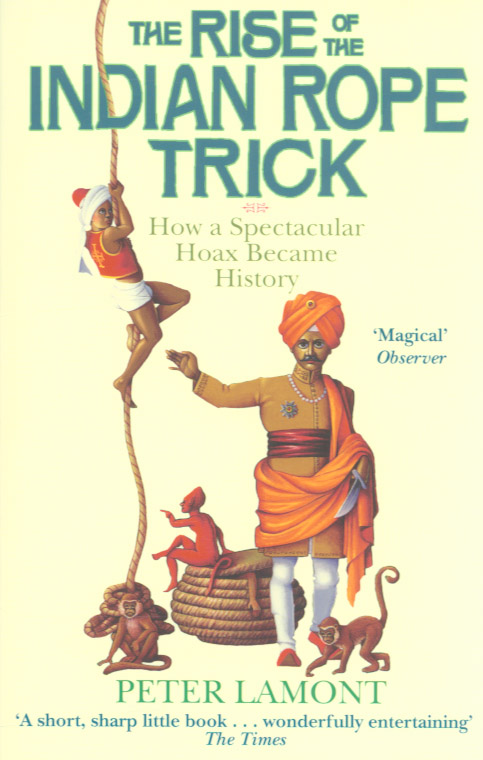 For example, there’s the Indian Rope Trick. How could any
rational person believe such a story, which, on its face, is as absurd as that
of a woman giving birth to rabbits? This alleged trick involves an Indian fakir
who throws a rope to the sky, but the rope does not fall back to the ground.
Instead it mysteriously rises until the top of it disappears into thin air. A
young boy climbs the unsupported rope, which miraculously supports him until he
also disappears into thin air. The fakir then pulls out a knife and climbs the
rope until he, too, disappears. Body parts fall from the sky into a basket next
to the base of the rope. The fakir then slides down the rope, empties the
basket, throws a cloth over the scattered body parts, and the boy miraculously
reappears with all his parts in the right places. Thousands of people claim to
have witnessed this trick that never happened.
For example, there’s the Indian Rope Trick. How could any
rational person believe such a story, which, on its face, is as absurd as that
of a woman giving birth to rabbits? This alleged trick involves an Indian fakir
who throws a rope to the sky, but the rope does not fall back to the ground.
Instead it mysteriously rises until the top of it disappears into thin air. A
young boy climbs the unsupported rope, which miraculously supports him until he
also disappears into thin air. The fakir then pulls out a knife and climbs the
rope until he, too, disappears. Body parts fall from the sky into a basket next
to the base of the rope. The fakir then slides down the rope, empties the
basket, throws a cloth over the scattered body parts, and the boy miraculously
reappears with all his parts in the right places. Thousands of people claim to
have witnessed this trick that never happened.
Actually, the only
thing needed for this trick is human gullibility. According to Peter Lamont, a
researcher at the University of Edinburgh and a former president of the Magic
Circle in Edinburgh, the Indian Rope Trick was a hoax played by the Chicago
Tribune in 1890. Lamont claims the newspaper was trying to increase
circulation by publishing this ridiculous story as if there were eyewitnesses
to the event. The Tribune admitted the hoax some four months later,
expressing some astonishment that so many people believed it was a true story.
After all, they reasoned, the byline was “Fred S. Ellmore.” They hadn’t
reckoned that their audience, many of whom believe in magicians with miraculous
powers, wouldn’t find this story that hard to accept.
Our next hoax is about
an event that really did happen in India. Ramar Pillai astounded the world when
he announced that he could change water into diesel fuel. He claimed he had
some magic herbs that, when added to boiling water, could produce a virtually
pollution-free diesel fuel or kerosene for about twenty-three cents a
gallon—not quite as impressive as Pons and Fleishmann’s cold-fusion claim, but
impressive nonetheless. Pillai was promoted on the Internet as the new Isaac
Newton. To produce his fuel, Pillai cooked leaves and bark from a special plant
for about ten minutes in hot water. He stirred the mixture and let it cool
down. The liquid fuel would float to the top and be separated by filtering. The
entire process took less than thirty minutes.
His fuel was allegedly
tested at the Indian Institute of Technology and was shown to be a pure
hydrocarbon similar to kerosene and diesel fuel. Engineers conducted tests and
concluded that the herbal fuel offered better fuel economy than gasoline. One
scientist tried to explain the magic by offering the theory that atmospheric
carbon dioxide might be sucked in during the reaction. The carbon dioxide
combines with hydrogen liberated from water and forms the hydrocarbon fuel. A
better explanation seems to be that Pillai’s stirring stick is filled with fuel
and when his mixture is heated up, a wax plug at the end of the stick melts,
liberating the fuel. Pillai, it seems, was part of gang who hoped to trick
people into buying fuel they’d stolen from Indian oil companies. Pillai was very
convincing in his role as a peasant-genius. I remember reading one news account
in which he described how he’d been kidnapped and tortured by a gang trying to
wrest from him his secret recipe. He described how he’d been hung from a
ceiling fan and burned with cigarettes. Poor fellow.
Cabrera’s Stones
Next, we go to Peru
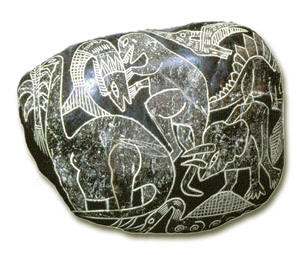
and Dr. Javier Cabrera’s stones. Dr. Cabrera gave up his medical practice in
1996 to open a museum for some stones he bought from a local farmer that depict
stylized men who look like ancient Incas or Aztecs. What is unique about these
stones is that they depict activities such as astronomy and surgery, indicating
a very advanced civilization. Furthermore, there are also stones that are said
to show extinct fish and humans riding dinosaurs. The stones are said to
provide evidence that the ancient locals not only had an advanced civilization,
but they lived at the time of the dinosaurs. The stones call into question just
about everything science has taught us about the origin of our planet, ourselves,
and other species. The farmer who sold Dr. Cabrera the stones at first claimed
that he had found them in a cave, but later admitted that he made them himself
to sell to tourists.
Even though this hoax
was created for a tourist trade, there are three groups in particular who have
endeavored to support the authenticity of the stones: (1) the followers of
Erich von Däniken (author of Chariots of the Gods?) and those who
believe that extraterrestrials are an intimate part of Earth’s “real” history
and were the ones who brought advanced civilization to the ancient Indians; (2)
fundamentalist creationists who drool at the thought of any possible error made
by anthropologists, archaeologists, or evolutionary biologists, and who relish
the thought of evidence that humans, dinosaurs, and extinct fish lived together
a few thousand years ago; and (3) the mytho-historians, followers of Immanuel
Velikovsky or Zecharia Sitchin who claim that ancient myths are accurate
historical records to be understood literally.
Any rational person
examining all the evidence should conclude that the probability is about zero
that these stones are evidence of extraterrestrials or the validity of ancient
myths or proof that men lived with dinosaurs. But if you already believe that
extraterrestrials have been among us for millennia, then you may well find the
extraterrestrial account plausible or even probable. Likewise, if you believe
that Earth is only a few thousand years old and are well-versed in Flintstone
science, then the idea that these stones depict actual events may well be
believable to you.
The
Visions of Catalina Rivas
Catalina
Rivas of Cochabamba, Bolivia, was a “fallen-away Catholic” until 1993, when she
went to see a woman named Nancy Fowler. Fowler is from Conyers, Georgia, and
for several years claimed that the Virgin Mary appeared to her on the
thirteenth of each month (à la Fatima). Rivas claims she went to Conyers and
had her first stigmatic experience there. You may have seen Rivas in the July
1999 Fox television special “Signs from God: Science Tests Faith.” A more apt
title would have been: “Dollar Signs: Fox Tests Gullibility.” In that program,
reporters Giselle Fernandez and Michael Willesee took viewers on an uncritical
tour to “scientifically” examine weeping and bleeding statues, rose petals with
“miraculous” images of Jesus and Mary, and the stigmata of Katya Rivas,
among
other things.

Rivas is hailed by her
thousands of admirers as the spiritual mother of not one but two international
religious movements, The Great Crusade of Love and Mercy and the Apostolate of
the New Evangelization. In 1996, she claimed she was getting messages from God,
not only in Spanish but also in Greek, Latin, and Polish. These allegedly
divine messages were photocopied and sold at religious rallies. Her bishop,
René Fernández Apaza, authenticated both her stigmata and her messages from
God.
On June 22, 2001, I received
an e-mail from a man named José H. Prado Flores, who told me that he was “a
writer of books oriented to forming leaders in the Catholic Church.” Several
years ago, he wrote, he had co-authored a book with Salvador Gómez called Formación
de Pedicadores (“Training Preachers”) and that Katya Rivas had rewritten
their book as “messages from Jesus ‘dictada a la sierva de Dios’
(‘dictated to God’s servant’).” He told me that when Rivas, “the famous
‘visionary and stigmatic’” was scheduled to appear at a religious rally in
Guadalajara, Mexico, where Prado Flores lives, a friend showed him a set of
books that were to be sold during the convention. “You can understand my total
amazement,” he wrote, “when I put two and two together and figured out she was
the same lady that had ‘stolen’ my book. We then went to the bishop of
Guadalajara, Juan Cardenal Sandoval Iñiguez, who, after seeing our study on her
material, immediately cancelled her participation.”
Why, you might wonder,
would a Catholic author contact an atheist who is skeptical of all things
miraculous about this matter? José had read my rather unflattering review of
the Fox special, and said he wanted any information I might have that would
help prove that Rivas “is a compulsive and professional liar.”
For over a year and a
half, I exchanged e-mails with José and his wife Susan about Catalina Rivas. I
obtained copies of his book and copies of her messages. I established that he
and Salvador Gómez had written hundreds of pages that are nearly identical to
the material being published by Rivas, and that the pair of Mexican authors had
written some of the material at least sixteen years before Katya’s “messages.”
My edition of Formación de Predicadores is dated 1992, four years before
her messages, which have page after page of nearly verbatim plagiarizing.
To her followers who
ask me how it is possible for a peasant woman with no formal education to write
books in Spanish, Polish, Greek, and Latin, I say it is simple: she copies
them. It seems obvious that she did it for her Spanish messages from Jesus,
and I suspect that if the Bishop who authenticated her stigmata would have put
a little more energy into authenticating her messages, he would find the same
is true for her works in other languages as well.
Channeling
Dr. Fritz
Another whopper began
with Zé Arigó (1918—1971), a Brazilian faith healer who, in the early 1950s,
claimed to channel the spirit and healing power of Dr. Adolf Fritz, a German
doctor who allegedly died during World War I. Arigo developed quite a
reputation as a faith healer and psychic surgeon, but his ploy seemed to have
been aimed at directing business toward his brother, a pharmacist. He would
write out illegible prescriptions for people that only his brother could read.
People came from far and wide to be cured by Arigo. His reputation soared after
it was alleged that he did a bit of psychic surgery and removed a cancerous
tumor from the lung of a well-known Brazilian senator. For twenty years,
Arigó’s fame spread as he “cured” and “operated” on thousands of people,
including the daughter of Brazil’s president. Despite his fame, he was twice
convicted of practicing medicine illegally.
Arigo performed his
psychic surgery with a pocketknife and a heavy German accent, perhaps to
misdirect people so they wouldn’t notice his lack of concern for medical
hygiene.
Arigo died in a car
crash in 1971, but Dr. Fritz didn’t go with him. He took over the body of
another Brazilian healer who went by the name of Oscar Wilde. (I’m not making
this up.) Wilde didn’t last too long before he, too, died a violent death.
After that, a gynecologist from Recife, Dr. Edson Queiroz, claimed Dr. Fritz
was his. The doctor, however, was stabbed to death in 1991.
The current channeler
of Dr. Fritz is engineer Rubens Farias Jr., who heals the astral body with
energy healing and does some psychic surgery with unconventional instruments
such as scissors. Farias is also unique in that he claimed Dr. Fritz came to
him in 1986, while Dr. Queiroz was still alive. I had to consult Thomas Aquinas
to see whether it is possible for the same spirit to appear in two bodies
simultaneously; it turns out spirits don’t occupy space so they can be
everywhere at once. Anyway, despite the dual channeling and the fact that he
has also been accused of practicing medicine without a license, Farias has
endless lines of people with faith in miraculous cures waiting for a bit of his
magic.
Exposing
the Hoaxes
Some skeptics suggest
that the best way to undermine such faith and enlighten people is to
demonstrate how easy it is to fake the paranormal and the supernatural. I’m not
so sure. I think we could expose dozens of fake healers, but it would not make
it any easier to expose the next one who comes along because we wouldn’t be
destroying the underlying belief system that is needed to make the faith healer
plausible. I believe this partly due to what happened with a fake psychic and a
fake channeler who were sent to Australia to enlighten the people.
In 1986, Mark Plummer,
former president of the Australian Skeptics and former Executive Director of
CSICOP, and Dick Smith, a patron of the Australian Skeptics, invited magician
and mentalist Bob Steiner to come to Australia to perform as a psychic. Steiner
often pretends he is an astrologer, tarot card reader, palm reader, or a
psychic. After his performances he reveals that he is not psychic but uses
trickery and deceit to fake paranormal powers.
For two weeks, Steiner
hoaxed Australia as Steve Terbot. He appeared on television programs, gave
performances at cultural centers, and in a very short time became a hit. He
appeared on Tonight with Bert Newton (similar to The Tonight Show)
three times and in his last appearance revealed the hoax, explaining that he
used cold-reading techniques and other tricks to deceive people into thinking
he was psychic. The purpose of the hoax was to “warn the people of Australia to
beware of people claiming to be psychics.” Plummer and Smith had brought
Steiner to Australia because of a fairly large influx of foreign psychics who
were being welcomed and accepted with incredible credulity by the natives. They
hoped that once the people saw how easy it is to fake being psychic, they would
see the error of their ways.
Did it work? According
to Steiner, it worked extremely well and effectively put an end to the influx
of foreign psychics. Mark Plummer agreed. Here’s what he told me in a recent
e-mail message when I asked him whether he thought the hoax did any good:
Yes. Before then
Australia was regularly visited by “internationally known” psychics. Since then
we have only had a couple. Also the organisers are terrified that if they
promote someone that person will turn out to be a skeptic.
To put it in a wider
international context: Before, there were skeptics groups in most countries
[but] individuals had no easy way of checking up on the claims of
“international psychics.” Once CSICOP could act as a central library and
clearing house and the national skeptics groups started talking to each other
it became much harder for such charlatans to operate internationally. Then,
with the invention of the fax and the Internet, the exchange of skeptical
information has become much easier.
Steiner also exposed a
man named John Fitzsimons as a fraud, paving the way for a $64,000 judgment on
behalf of one of Fitzsimons’s clients. Seventeen years later, however, I found
Fitzsimons on the Internet. He runs a New Age group called Aspects in a small
town outside of Melbourne. He leads discussions on topics such as past lives,
karma, out-of-body experiences, spirit guides, prayer, healing, White Eagle (a
channeled being), multiple personality disorder, mediumship, cults, night
terrors, spiritualism, psychic readings, exorcism, Ouija, channeling, Seth,
aliens, Atlantis, UFOs, and chronic fatigue syndrome. In short, Steiner was
about as successful in putting away Mr. Fitzsimons as he and Randi were in
putting away Peter Popoff, the faith healer they exposed as a fraud in 1986.
Speaking of the
Amazing Randi, a tour of world hoaxes would not be complete without a
discussion of the “Carlos” hoax. According to Randi, in 1988, channeling was
the rage in Australia, and an Australian television program contacted him about
finding someone who might go down under and pretend to be a channeler. The plan
was similar to the Steve Terbot hoax. This time, José Alvarez would channel an
ancient spirit he called Carlos. Alvarez would tour Australia, appear on TV,
and appear in various venues, including the Sydney Opera House. At the end of a
few weeks, the hoax would be revealed. Again, the purpose was to enlighten
Australians by demonstrating how easy it is to fake channeling. Like Steiner,
Alvarez was very convincing and he had a large following in a very short time.
And, in the end, everything was revealed.
Did the hoax work? Was
anybody enlightened? I was able to discuss this question at length with both
Alvarez and Randi while at the JREF Amazing Meeting in February 2003. Both
think the hoax accomplished its mission. In fact, Alvarez continues to take
Carlos on the road in an effort to enlighten people with what he calls
“performance art.”
What was most
revealing about both the Steve Terbot and Carlos hoaxes was how the media
didn’t bother to check their credentials or their claims about themselves. The
media took it for granted they were who they said they were and did what they
said they did. Looking to the media for protection against being hoaxed is
probably an exercise in futility. So, here is valuable lesson number two: Don’t
expect help from the mass media.
Nevertheless, I sought
the opinion of someone in the Australian media and asked him if he thought
there were any benefits or long-term effects of either the Steve Terbot or the
Carlos hoaxes. I tried to contact Phillip Adams, a well known Australian journalist,
writer, and media personality. Adams wasn’t directly involved with either hoax.
In fact, he was writing scathing articles condemning the phony psychics
plaguing the land during the time Bob Steiner was gathering his flock as
psychic Steve Terbot. Adams was out in the bush or someplace where they don’t
have e-mail when I tried to contact him, but his assistant, Amanda Bilson, got
in touch with him and relayed this message:
. . . he asked me to
pass on a couple of comments to you. First of all he wasn’t involved with the
Randi/Terbot hoax[es] and is not convinced [they were] entirely successful.
Perhaps the media learned to be a little more sceptical—but they soon returned
to their old standards of gullibility. And many people blame the messenger for
the message, turning their anger on the Sceptics rather than the charlatans. He
thought [they were] great fun but, given the attention span of public and media
alike, of little long term significance.
Recently, Michael
Shermer, of the Skeptic Society, discovered the same thing: It’s easy to hoax
people and it’s great fun, but rather than enlighten people, it seems that you
just anger some of them. Shermer used the cold-reading techniques described by
Ian Rowland in his book The Full Facts Book of Cold Reading and
pretended to be a tarot card reader, a palmist, an astrologer, a psychic, and a
medium who could get messages from the dead. He did this on camera with five
strangers who did not know who he was or what he was doing. He seems to have
been pretty successful in convincing his clients of his paranormal powers.
However, when he revealed to them that the whole thing was a hoax, two were so
upset that they refused to sign a release to use the material in the show he
was filming. Three of his subjects were college students who seemed less
concerned about being duped than in finding out when they would be on TV. If
any of them thanked Shermer for helping them see the truth about the
paranormal, he didn’t mention it.
So what can we learn from all this? Well, it’s pretty easy to hoax people. Pascal is right: We want to be deceived, and that makes it easy to hoax us. Also, many of us already have beliefs that make us vulnerable to being hoaxed about certain kinds of things. Furthermore, most of us enjoy being deceived by a good magician or by someone pulling off a non-malicious prank or hoax.
But we don’t always
want to be deceived. We don’t want to be made to look like idiots or be led
into believing something foolish. Nor do we ever wish to be defrauded. And most
of us don’t like that uncomfortable feeling that rises in us when we’re not
sure whether we’re being hoaxed. We know some hoaxes are benevolent and
pleasant, while others are malicious and unpleasant. Ideally, we’d like a surefire
way to tell the difference so we’d never be hoaxed against our will.
That’s why I wrote the
book Don’t Get Hoaxed, in which I explain such things as the hoax-prone
personality: the person who is trusting and honest; attracted to attractive
people; believes the believable and the unbelievable; and lacks a good
understanding of confirmation bias and cold-reading techniques.
I also reveal that if
you map out the locations of the world’s greatest hoaxes, you will find that
they lay along ley lines that, when connected by a line to the north star at
the vernal equinox, form a pyramid with the exact proportions as the Great
Pyramid of Giza.
Coincidence? I don’t
think so.
Trust me, I teach
ethics.
References
- Carroll, Robert Todd. 2003. The Skeptic’s Dictionary: A Collection of Strange Beliefs, Amusing Deceptions, and Dangerous Delusions. Hoboken, New Jersey: John Wiley & Sons. Also online at www.skepdic.com.
- Levine, Robert. 2003. The Power of Persuasion: How We’re Bought and Sold. Hoboken, New Jersey: John Wiley & Sons.
- Pickover, Clifford A. 2000. The Girl Who Gave Birth to Rabbits: A True Medical Mystery. Buffalo, New York: Prometheus Books.
- Polidoro, Massimo. 2002. Ica stones: Yabba-dabba do! Skeptical Inquirer 26(5): September/October.
- Randi, James. 1989. The Faith Healers. Buffalo, New York: Prometheus Books.
- ———. 1982. Flim-Flam! Psychics, ESP, Unicorns, and Other Delusions. Buffalo, New York: Prometheus Books.
- Rowland, Ian. 2002. The Full Facts Book of Cold Reading. 3rd ed. London: Ian Rowland Limited.
- Shermer, Michael. 2003. Psychic for a day, or how I learned tarot cards, palm reading, astrology, and mediumship in 24 hours. Skeptic 10(1): 48—55.
- Stein, Gordon. 1995. Hoaxes!: Dupes, Dodges & Other Dastardly Deceptions. Canton, Michigan: Visible Ink Press.
- Steiner, Robert A. 1989. Don’t Get Taken!—Bunco and Bunkum Exposed: How to Protect Yourself. El Cerito, California: Wide-Awake Books.
- http://www.augustachronicle.com/stories/041102/biz_UE0007-0.shtml (“Woman gives birth to rabbits! Or so they said . . . ,” by Michael Woods, The Augusta Chronicle, April 11, 2002).
- http://home.vicnet.net.au/~johnf/biogjfit.htm (John Fitzsimons).
Robert
Carroll
Robert Carroll is
co-chairman of the Philosophy Department at Sacramento City College in
California and creator of the skeptical Web site www.skepdic.com and author of the book The Skeptic’s Dictionary. This
article is based on his talk at the CSICOP conference on “Hoaxes, Myths, and
Manias,” Albuquerque, New Mexico, Oct. 23—26, 2003.